
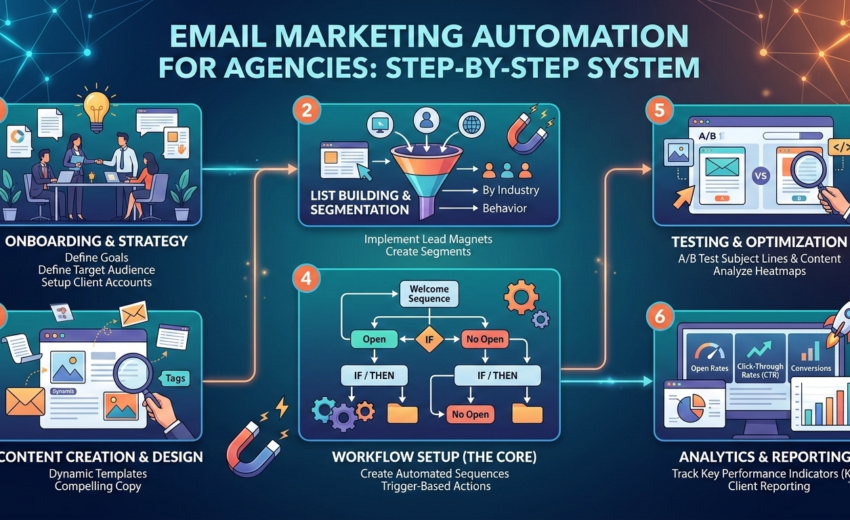
Email Marketing Automation for Agencies: Step-by-Step System
In the modern digital marketing landscape, agencies face an ever-growing demand to deliver results efficiently. Email marketing remains one of the most effective channels for driving engagement, conversions, and client retention. However, manually managing email campaigns for multiple clients can be overwhelming. This is where email marketing automation becomes a game-changer. By automating workflows, agencies can save time, scale campaigns, and achieve better results.
In this article, we will break down a step-by-step system for implementing email marketing automation tailored for agencies.
Why Email Marketing Automation Matters for Agencies
Before diving into the steps, it’s important to understand why automation is crucial:
Scalability – Automating repetitive tasks allows agencies to manage multiple clients without sacrificing quality.
Consistency – Automated workflows ensure emails are sent at the right time with the right message.
Personalization at Scale – Automation enables segmentation and personalized content without manual effort.
Better Analytics – Automated campaigns provide real-time performance insights, allowing agencies to optimize continuously.
By leveraging automation, agencies can offer a higher level of service while focusing on strategy and creative development.
Step 1: Define Goals and KPIs
Every campaign starts with clear objectives. Common goals for agencies include:
Increasing client leads
Boosting e-commerce sales
Improving brand engagement
Nurturing existing customers
Once goals are defined, set measurable Key Performance Indicators (KPIs), such as:
Open rate
Click-through rate (CTR)
Conversion rate
Revenue per email
These metrics will guide your campaign strategy and provide a benchmark for success.
Step 2: Segment Your Audience
Effective email marketing automation relies on accurate audience segmentation. Segmentation can be based on:
Demographics (age, location, gender)
Purchase behavior
Engagement level (active vs. inactive subscribers)
Lifecycle stage (lead, prospect, customer)
Segmenting ensures that each email resonates with the recipient, increasing engagement and conversions.
Step 3: Choose the Right Automation Tools
Agencies need robust email marketing platforms that support automation. Popular options include:
HubSpot – Offers advanced workflows and CRM integration
ActiveCampaign – Great for small to mid-size agencies
Mailchimp – Beginner-friendly with automation features
Klaviyo – Ideal for e-commerce client campaigns
When choosing a tool, consider features like:
Drag-and-drop email builders
Workflow automation
Advanced segmentation
Reporting and analytics
Integration with CRM and other marketing tools
Step 4: Create Automated Workflows
Automation works best with predefined workflows. Here’s a typical structure agencies can implement:
Welcome Sequence – Sends new subscribers a series of emails introducing the brand, services, or products.
Lead Nurturing Sequence – Gradually educates leads and moves them toward conversion.
Abandoned Cart Sequence – E-commerce-specific automation that reminds customers of items left in their cart.
Re-engagement Sequence – Targets inactive subscribers to revive interest.
Each workflow should have trigger events, timing rules, and personalized messaging. Automation platforms make it easy to set these conditions without manual intervention.
Step 5: Craft Engaging Content
Automation is only as effective as the content it delivers. Best practices for email content include:
Clear subject lines that encourage opens
Personalized greetings using subscriber data
Concise and valuable body copy
Strong call-to-action (CTA)
Mobile-friendly design
Incorporation of dynamic content based on segments
Remember, automation allows you to send the right content to the right audience at the right time.
Step 6: Test and Optimize
Even automated campaigns need ongoing optimization. Key strategies include:
A/B Testing – Test subject lines, CTAs, and email designs to see what performs best.
Monitor Analytics – Track KPIs regularly to identify areas for improvement.
Refine Segmentation – Update segments based on subscriber behavior.
Adjust Timing – Experiment with sending times to maximize engagement.
Continuous testing ensures your automation performs at peak efficiency for all clients.
Step 7: Report Results to Clients
Agencies must provide clients with transparent reporting. Include:
Campaign performance metrics (open rates, CTR, conversions)
ROI analysis
Recommendations for improvement
Insights from A/B tests and engagement trends
Reporting not only demonstrates value but also builds trust and positions your agency as a strategic partner.
Bonus Tips for Agency Success
Leverage Integrations – Connect email automation with CRM, social media, and analytics platforms.
Maintain List Hygiene – Remove inactive subscribers to improve deliverability.
Stay Compliant – Follow GDPR, CAN-SPAM, and other regulations to avoid penalties.
Use Behavioral Triggers – Send emails based on user actions, like clicks or purchases, to boost relevance.
Conclusion
Email marketing automation is no longer optional for agencies—it’s essential. By following this step-by-step system, agencies can:
Save time and resources
Deliver personalized campaigns at scale
Improve ROI for clients
Enhance reporting and insights
With the right strategy, tools, and workflows, agencies can transform their email marketing efforts into a highly efficient, results-driven system.
Advanced Technical SEO Guide: 2026 (Step-by-Step Guide)
one21slots March 26, 2026
Spinning some reels over at one21slots. They have a decent selection of games. Wish me luck!