

Technical SEO Guide for Beginners (2026)
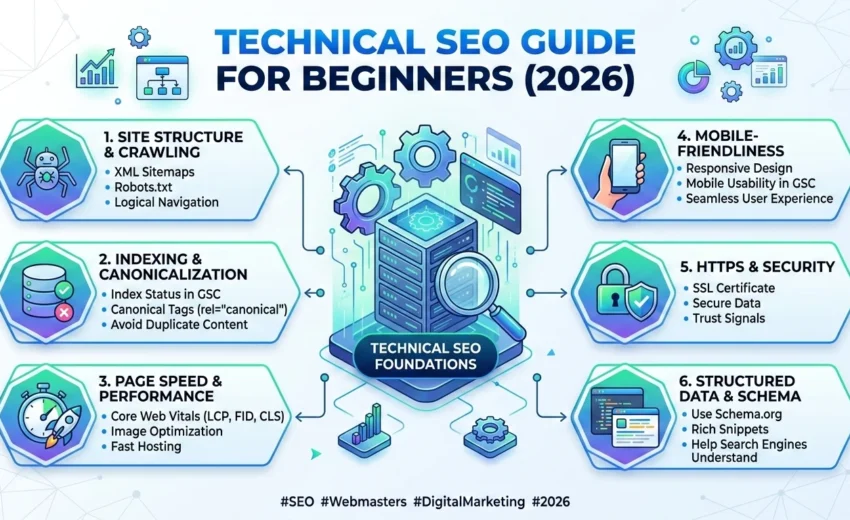
Search engine optimization (SEO) is evolving rapidly, and mastering technical SEO has never been more important. This Technical SEO Guide for Beginners (2026) is designed to help you optimize your website’s infrastructure so that search engines can crawl, index, and rank your content effectively.
Whether you’re just starting out or looking to strengthen your website foundation, this guide covers essential strategies, tips, and best practices for 2026.
1. What is Technical SEO? Beginner’s Guide 2026
Technical SEO focuses on the backend structure of your website rather than content. It ensures that search engines can access and interpret your pages while providing an excellent user experience.
Key elements of technical SEO include:
Website speed and performance
Mobile-friendliness
Secure connections (HTTPS)
Clean URL structure
XML sitemaps and robots.txt
A strong technical SEO foundation is the first step in improving rankings, even if your content is top-notch.
2. Optimize Website Speed for SEO in 2026
Website speed is a critical factor for both users and search engines. Slow pages lead to higher bounce rates and lower rankings.
Checklist:
Compress images without losing quality
Enable lazy loading for media
Minify CSS, JavaScript, and HTML
Use a Content Delivery Network (CDN)
Enable browser caching
Optimizing page speed is a key part of the Technical SEO Guide for Beginners (2026).
3. Ensure Mobile-Friendliness
Mobile-first indexing is standard for Google in 2026. Your mobile site is the primary version that search engines evaluate.
Checklist:
Implement a responsive design
Ensure buttons and links are easy to tap
Optimize images for mobile display
Avoid intrusive interstitials
Mobile usability is essential for technical SEO success.
4. Use HTTPS for Website Security
Secure websites rank better and gain user trust. Switching to HTTPS is now standard practice.
Checklist:
Obtain and install a valid SSL certificate
Redirect all HTTP pages to HTTPS
Update internal links and sitemaps
Check for mixed content issues
Security is a major part of the Technical SEO Guide for Beginners (2026).
5. Optimize Site Architecture and URL Structure
A clean, logical structure improves crawling, indexing, and user navigation.
Checklist:
Use keyword-rich, descriptive URLs
Keep URLs short and readable
Organize content into categories and subcategories
Implement internal linking for related content
A strong site architecture is a cornerstone of effective technical SEO.
6. Create and Submit XML Sitemaps
XML sitemaps help search engines discover all important pages.
Checklist:
Include all indexable pages
Submit to Google Search Console
Update regularly as content changes
Avoid including noindex pages
This ensures your website is fully crawlable.
7. Configure Robots.txt Correctly
The robots.txt file controls which pages search engines can crawl.
Checklist:
Block admin pages and duplicate content
Ensure important pages are not accidentally blocked
Test using Google Search Console
Proper robots.txt configuration improves crawl efficiency.
8. Implement Structured Data (Schema Markup)
Structured data helps search engines understand your content and enables rich results.
Checklist:
Use schema for articles, products, events, FAQs
Validate with Google Rich Results Test
Keep markup updated with content changes
Structured data boosts visibility in search results.
9. Fix Crawl Errors Regularly
Crawl errors can prevent pages from being indexed properly.
Checklist:
Monitor Google Search Console for errors
Fix 404 pages with redirects or updates
Resolve 5xx server errors promptly
Maintain updated sitemaps and links
Regular audits are part of ongoing technical SEO maintenance.
10. Optimize Core Web Vitals
Google emphasizes Core Web Vitals as a ranking factor in 2026.
Checklist:
Largest Contentful Paint (LCP): Improve load speed
Cumulative Layout Shift (CLS): Ensure visual stability
First Input Delay (FID): Enhance interactivity
Optimizing these metrics is critical for technical SEO success.
11. Use Canonical Tags to Avoid Duplicate Content
Duplicate content can harm rankings. Canonical tags indicate the preferred version of a page.
Checklist:
Add canonical tags on duplicate pages
Avoid publishing multiple URLs with identical content
Monitor and fix duplicate content issues
Canonicalization consolidates ranking signals and prevents penalties.
12. Regular Monitoring and Audits
Technical SEO is ongoing. Regular audits ensure your website remains optimized.
Checklist:
Use tools like Google Search Console, Screaming Frog, Ahrefs, or SEMrush
Track crawl errors, page speed, mobile usability, and indexing
Update technical SEO strategies based on algorithm changes
Conclusion
Following this Technical SEO Guide for Beginners (2026) ensures that your website is fully optimized for search engines and users alike. By focusing on speed, mobile-friendliness, structured data, and Core Web Vitals, beginners can create a strong SEO foundation.
Technical SEO is no longer optional—it’s the backbone of successful websites in 2026. Implementing these strategies will improve rankings, drive more traffic, and enhance user experience.
Local SEO Strategies for Small Businesses